
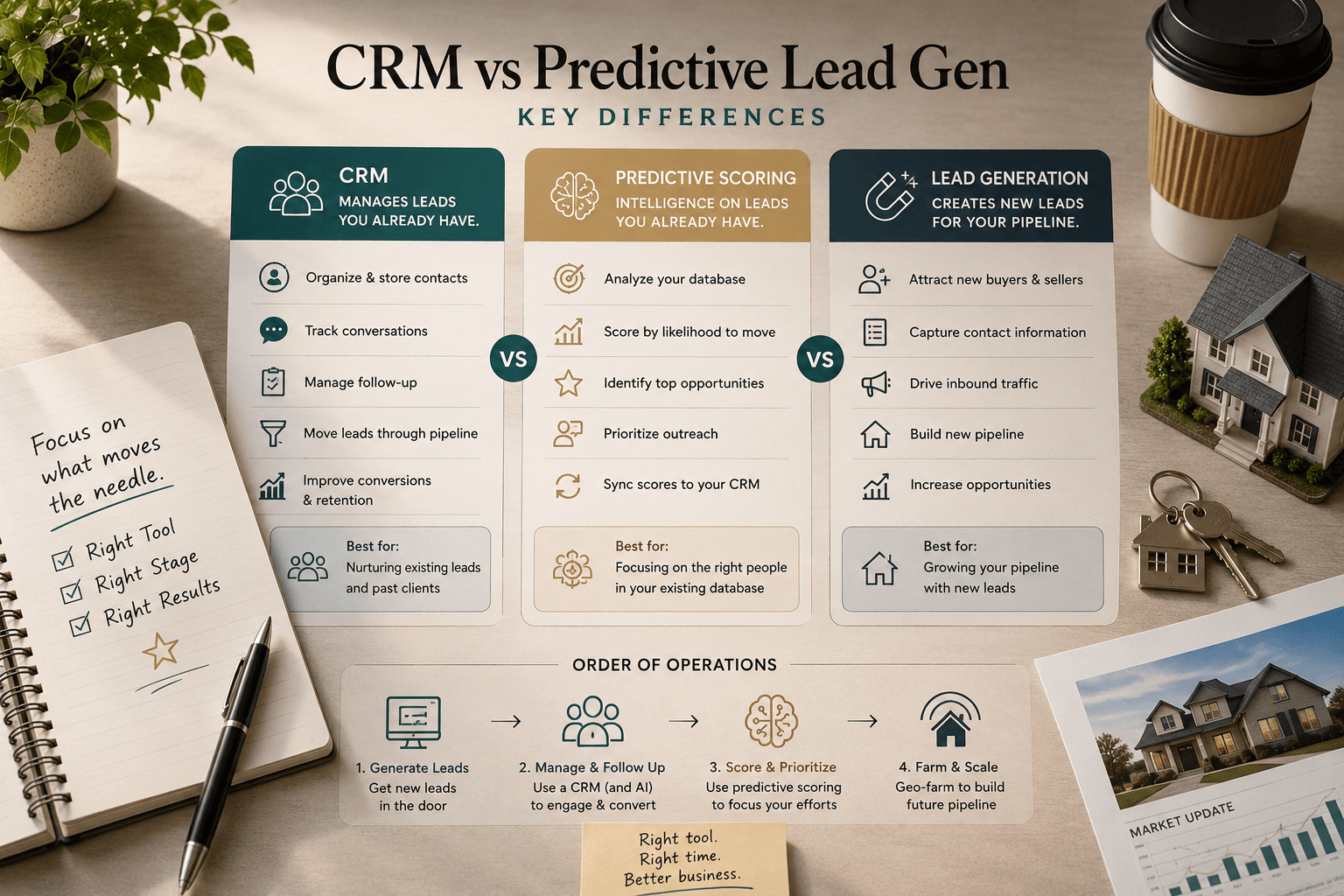
The most common mistake agents make when evaluating AI tools for their real estate business is shopping for the wrong category. An agent who needs better follow-up on existing leads buys a predictive farming tool. An agent who needs new seller leads buys a CRM upgrade. The tools underperform not because they're bad — but because they're solving a different problem.
The confusion is understandable. The marketing for real estate tech products is deliberately blurry. "AI-powered lead intelligence" could describe a CRM feature, a predictive analytics tool, or a lead generation platform. Understanding what each category actually does is the prerequisite to evaluating any specific product.
What a CRM does
A CRM — Customer Relationship Manager — is a database for people you already know or have already made contact with. In real estate, that means:
- Leads who have submitted a form on your website
- Past clients from closed transactions
- Sphere-of-influence contacts you've added manually
- Leads imported from Zillow, Realtor.com, or other portals
The CRM's job is to make sure none of those people falls through the cracks. It tracks every communication — calls, texts, emails — assigns pipeline stages, routes leads to agents on a team, sets follow-up task reminders, and increasingly uses AI to draft responses, summarize call history, and suggest next actions.
Follow Up Boss is the most widely adopted real estate CRM at team scale. Its value is in the integrations — 250+ native lead sources feed directly into the CRM — and in the team accountability features that make it possible to manage multiple agents working the same lead pool. Lofty goes further: its agentic AI engages leads autonomously without requiring an agent to manually initiate follow-up. Real Geeks bundles a CRM with an IDX website so that leads generated by your organic search traffic flow directly into the CRM with no manual import.
The critical point: a CRM does not create new leads. It manages leads that already exist. If you have a CRM and a thin pipeline, you have a well-organized empty pipeline. The CRM is not the problem.
What a lead generation tool does
A lead generation tool creates new contacts for your pipeline. In real estate, this takes two forms:
Inbound lead generation drives buyers and sellers to take an action — filling out a form, requesting a home value estimate, signing up for market updates — that captures their contact information and intent. Ylopo does this with paid Google and Facebook ad campaigns. Real Geeks does it with IDX websites that rank organically for local home search terms. The lead arrives because they saw your marketing and responded to it.
Predictive lead generation is different. It doesn't wait for a buyer or seller to take action. It identifies which homeowners are statistically most likely to sell in the next 6–12 months, before they've listed their home or contacted any agent. Offrs and SmartZip do this for geographic territories — they score every homeowner in a zip code and rank them by sell-probability. Catalyze AI does it for a specific niche: heirs of recently transferred properties who are likely motivated sellers.
The output of a lead generation tool is new contacts — people who didn't previously exist in your database. That's meaningfully different from a CRM, which only manages people who are already there.
Where predictive scoring sits
Revaluate is the tool that sits between these two categories in a way that confuses most agents.
Revaluate doesn't create new contacts. It scores contacts you already have — your past clients, sphere of influence, anyone in your existing CRM — by likelihood of moving in the next 12 months. It surfaces the 5–10% of your database who are most likely to transact, so you can prioritize outreach to them.
This is neither a CRM (it doesn't manage your pipeline) nor traditional lead generation (it doesn't create new contacts). It's database intelligence — making your existing database more valuable by identifying the highest-probability opportunities within it.
Revaluate integrates with Follow Up Boss, Lofty, Sierra Interactive, and other CRMs to sync scores back into the contact record, so the intelligence is actionable within your existing workflow rather than requiring a separate system.
Which do you need first?
The answer depends on where your bottleneck actually is.
If you have a thin pipeline: you need lead generation before anything else. A CRM with no leads to manage is overhead, not leverage. Predictive tools like Revaluate have nothing to score if your database has fewer than a few hundred contacts.
Start with inbound lead generation — an IDX website through Real Geeks, or paid ad campaigns through Ylopo — to build the pipeline. Add a CRM once you have enough volume that leads are falling through the cracks without one.
If you have leads but poor follow-up: you have a CRM or AI ISA problem. Leads are coming in but not being contacted fast enough, not being nurtured long enough, or not being assigned correctly on a team. Follow Up Boss, Lofty, or Real Geeks' built-in CRM will address this directly.
If you have an active database of past clients but aren't generating repeat and referral business: you have a database intelligence problem. Revaluate is designed specifically for this. It surfaces which of your past clients are most likely to move in the next year, so you're calling the right people at the right moment rather than doing blanket outreach to everyone equally.
If you want to build a listing presence in a specific neighborhood: you need geo-farming tools — Offrs or SmartZip — rather than a CRM or general lead gen. These tools identify which specific homeowners in your target area are most likely to sell and run outreach campaigns on your brand to establish name recognition before the listing decision is made.
The order of operations for most agents
For a solo agent or small team building from scratch:
-
IDX website + CRM first. Real Geeks' all-in-one is the most practical starting point: the website generates leads from organic search, the built-in CRM captures them, and Geek AI fires a 2-minute first response. One platform handles lead generation, capture, and initial follow-up.
-
AI follow-up second. Once leads are coming in at volume, add a dedicated AI ISA — Ylopo's Raiya or Structurely — to make sure no lead goes uncontacted in the critical first window.
-
Database intelligence third. Once you have 500+ contacts in your CRM, Revaluate can identify your highest-priority outreach targets. This is where predictive scoring pays off — it's useless on a thin database.
-
Geo-farming fourth. Offrs or SmartZip make sense once you have the marketing budget and patience for 12–18 month nurture cycles. This is an investment in future pipeline, not a quick lead source.
The agents who get the most out of AI tools are those who understand which problem each tool solves — and buy in the order that matches where their actual constraints are.
For full reviews of all tools in these categories, see our best AI tools for real estate agents guide. For CRM-specific comparison, see our reviews of Follow Up Boss and Lofty. For predictive farming, see our Offrs review and SmartZip review.