
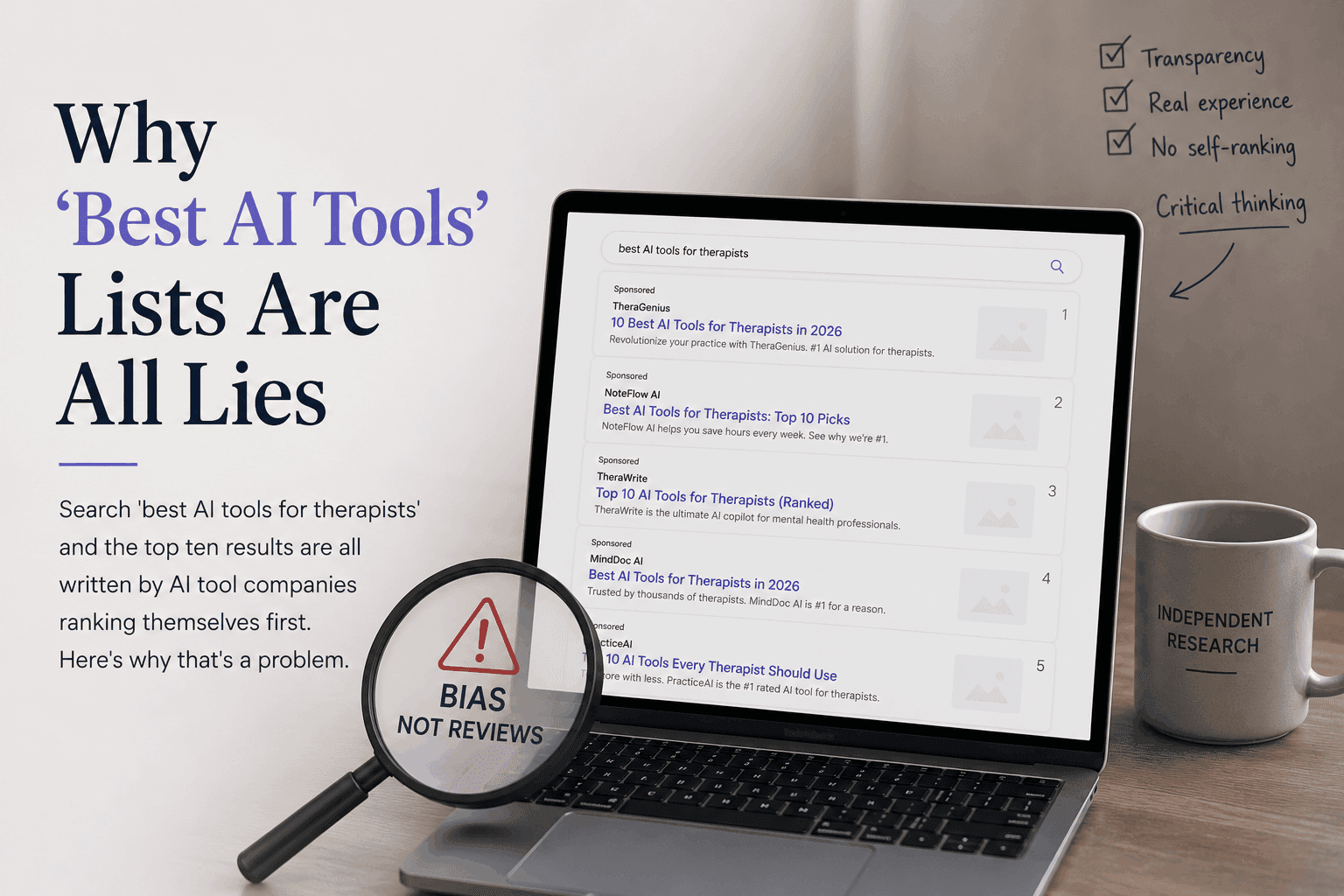
Search "best AI tools for therapists" right now. Count how many of the top ten results were written by a company that sells an AI tool to therapists.
Most of them. Often all of them.
This isn't a coincidence. It's the natural outcome of how search engine optimization intersects with software marketing. Content costs money to produce. Vendors have money. Vendors therefore produce the content. The content ranks. The content recommends the vendor's tool first.
The conflict of interest nobody discloses
Imagine asking a car salesperson which car is best. Now imagine they also own the dealership, write the car reviews for the local newspaper, and run the "independent" ranking website that appears on page one of Google.
That's the current state of AI tool content.
The typical pattern goes like this. A company builds an AI product. Their marketing team notices that nobody is ranking for "best AI tools for [profession]." They produce a roundup article. The article includes their tool — reviewed generously — plus four or five competitors reviewed briefly. The competitors' listings are accurate enough to seem credible but include only the cons that make the vendor's own product look better by comparison.
The piece ranks. People read it. They sign up.
Why "independent review sites" often aren't
The second tier is what appears at first glance to be independent content. Sites with names like "AI Tool Advisor" or "SoftwareReview.io." These usually fall into one of two categories.
Affiliate-first content. The site earns commissions on every signup. The conflict emerges when affiliate income becomes the primary editorial filter. Tools that pay higher commissions get featured more prominently. Tools that don't have affiliate programs disappear. Rankings are determined by contract terms, not quality.
Syndicated or AI-generated roundups. Writers produce multiple near-identical articles across dozens of domains. No hands-on testing happens. Screenshots are scraped from the tool's own marketing site. Pros and cons are synthesized from other reviews (which were themselves synthesized). The content is accurate to the tool's marketing copy, which means it's useless — marketing copy is designed to make products look good.
What honest evaluation actually looks like
A credible review of an AI tool for therapists requires, at minimum:
Running the tool through real sessions with real note-writing demands. Not a five-minute demo. At least several weeks across different note formats — SOAP, DAP, BIRP — and a range of session types.
Testing edge cases. How does it handle group therapy notes? Couples sessions? What happens when a client discloses something that requires immediate documentation of a safety concern?
Comparing against alternatives simultaneously, not sequentially across different test periods. Memory is unreliable. A reviewer who tested tool A six months ago and tool B last week will conflate their impressions.
Verifying compliance claims from primary sources. HIPAA compliance is not the same as having a BAA available. SOC 2 certification expires. A review that says "HIPAA compliant" without checking the vendor's actual security documentation is guessing.
Disclosing financial relationships explicitly — not in a footnote at the bottom of a 3,000-word article, but visibly, near the top, in plain language.
How to read any AI tool review
Before you act on a review, run through this checklist.
Who published it? If it's a vendor, a vendor-adjacent publication, or a site you've never seen review anything critically, weight it accordingly.
Are affiliate relationships disclosed? If the site never mentions how it earns money, it either earns nothing (rare, and usually means shallow coverage) or is hiding something (more common).
Does the reviewer name specific failures? Vague praise ("intuitive interface," "fast note generation") is easy to fabricate. Specific failures — "the EMDR template produces notes that don't satisfy my state's documentation requirements" — require hands-on time.
When was it written? AI tools update rapidly. A review from eight months ago may be describing a product that no longer exists. Look for a "last updated" date and take it seriously.
Does the top-ranked tool pay the highest commission? You can often check affiliate program terms publicly. If the number-one recommendation consistently pays 30% while a better-reviewed tool pays 10%, draw your own conclusion.
Why we built this site
We started this site because we couldn't find reviews that passed that checklist — starting with therapists, real estate agents, and teachers, and expanding from there. The content that existed was either vendor-produced, affiliate-optimized without real research, or simply outdated.
We currently have no affiliate relationships and earn nothing from any tool we cover. We do not accept paid placements, sponsored reviews, or vendor-submitted content. When a tool ranks first, it's because the research says it's the best option — not because of a commercial relationship.
That's a simple standard. It's also apparently rare enough that it needed saying.
If you want to see what honest testing looks like in practice: read our Mentalyc vs Upheal comparison for therapists, or the best AI tools for teachers guide — both include the specific failures we found alongside the genuine wins.